Free · By request · Any budget

Faded things, brought back.

The biggest myth in watches is that you need serious money to start. You do not. You need to know which neglected watch is worth saving, what saving it costs, and what it is worth once it runs again. That is the whole skill, and it is learnable.

Send us a listing and we will show you the arithmetic: what it costs to buy, what the work costs, what it is worth afterwards, and whether the gap is real. Plenty of tools price a clean watch. None of them price a broken one.

Assessments are done by hand right now, so there is a queue. Free while we are learning what people actually ask.

Invented reference · S-100
Not running · partial set · asking $4,200
Illustrative, not a valuation
Path Profit Months
Flip as-is$1,5402.0
Service, then sell$2,0604.3
Trade to dealer$6200.5
Hold 12 months$2,06012.0
Break-even ask, as-is$5,740
Break-even ask, serviced$6,290

Two high-severity risk flags open. No figure above means anything until they are resolved.

Why this exists

It started with one Seamaster.
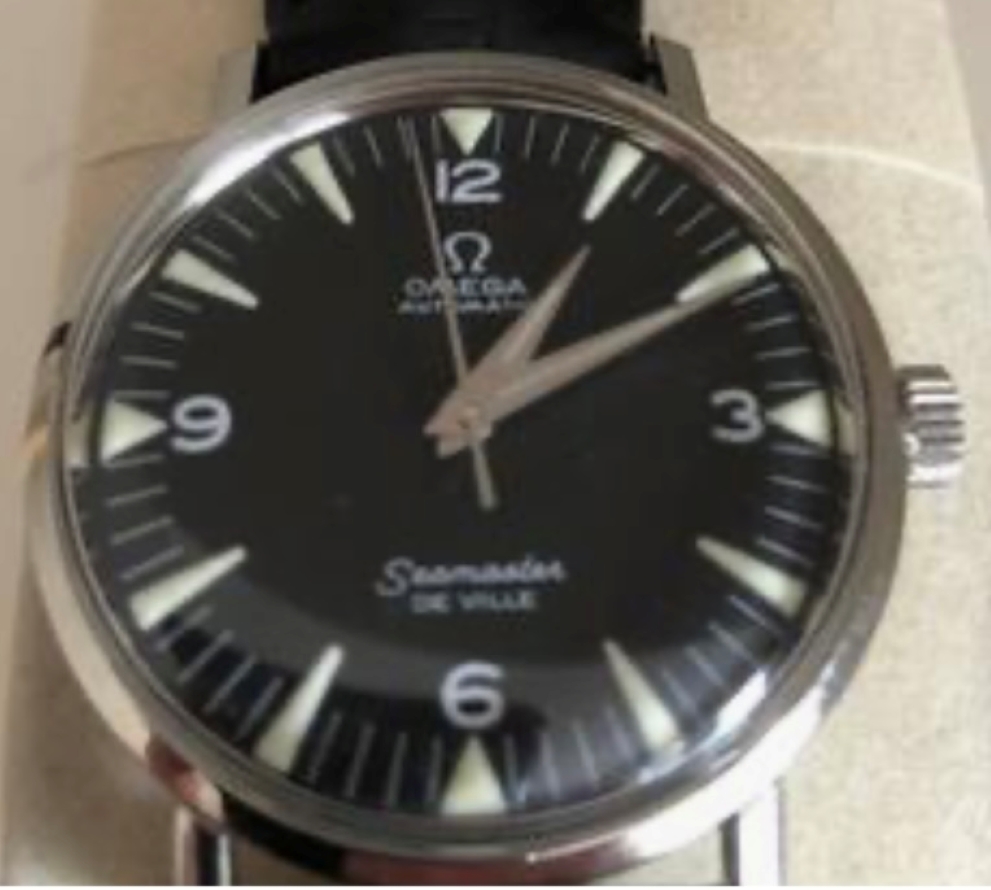
Mid-1960s Omega Seamaster De Ville, black dial with applied triangular markers and a railroad-track minute ring, on a black leather strap. The one I sold
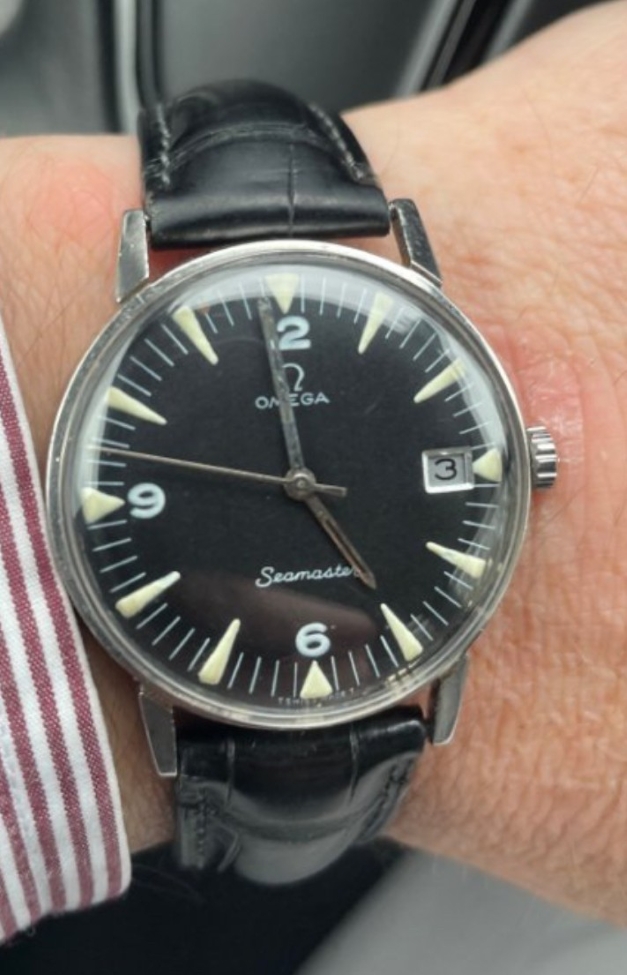
A near-identical Omega Seamaster with a black dial and date window, worn on the wrist on a black leather strap. The one I found again
Full circleSix hundred dollars, and it would not wind.

A mid-1960s Omega Seamaster De Ville. Six hundred dollars, and it would not wind. I bought it anyway, because I loved the Ranchero-style dial and that spare military look, and because six hundred dollars was what I had. It was not an investment and I never pretended it was.

I got it running, wore it for years, and eventually sold it to fund the next one. That watch paid for another, and that one for another. Years and a fair number of mistakes later, the line that started with that Seamaster ends at a Patek. Not quickly, and not in a straight line. Every step was the same arithmetic: is this worth saving, what does saving it cost, and what is it worth once it runs.

I also regretted selling it almost immediately, and spent years hunting for another. Last autumn I found one, near enough identical, and it is on my wrist as I write this. Both are Seamasters, incidentally. In the mid-sixties De Ville was still a Seamaster sub-brand rather than a collection of its own, which is why the older dial carries both names. Which tells you something about how this hobby actually works, and why the next section says what it says.

I am not a dealer with a showroom and I have never had capital sitting idle. Each watch paid for the next one. I built this to flatten the learning curve, because the knowledge that makes that possible is scattered across forums and often held by people with an interest in you not having it.

What I wish someone had told me

You do not need a Submariner to be a collector. A well-chosen vintage piece at a few hundred can be more interesting, more personal, and better value than anything in a boutique window.

"Needs service" scares off most buyers, which is exactly why it is where the value sits, provided the parts exist and the work is worth doing.

Restoring is not the same as making it shiny. The wrong intervention costs more value than it adds. Knowing the difference is most of the craft.

If vintage is where you want to stay, stay. Nobody has to graduate to anything.

The hardest part is not the money. It is watching a friend strap on a shiny new steel diver and fighting the urge to match it. That impulse has cost more collectors more money than any bad repair.

The value is in the hunt, and in having something to say when someone asks about your watch. A story you earned beats a boutique receipt every time.

And find people. I learned more in a small horological club that meets once a month than in years of reading forums.

How it works

Three steps, one honest answer.

You send the listing

Paste the listing text or a screenshot, plus anything you know that the listing does not say: whether it runs, what is in the box, what the seller has told you. We do not fetch the page ourselves, so what you send is what we work from.

We price every path

Acquisition cost including fees and duty, service cost and bench lead time, exit fees at each venue, and the capital tied up for each. The paths are compared on return and on time, not on headline profit.

You tell us what happened

Did you buy it, and what did it clear for. That single answer is how the assessments get better, and it is the only thing we ask in return.

The gap

Nobody prices the ones worth saving.

Every pricing tool in this market compares an ask against what a clean, working, full-set example trades for. Useful, widely available, mostly free, and no help at all on a watch that has been sitting in a drawer for thirty years. Those are the ones with room in them, and the ones most likely to be thrown away.

Service economics

What the work costs, what the queue is, and whether the uplift covers both. A watch that needs a service often trades at a discount far wider than the service bill. Not always.

Parts availability

The first question is not whether it can be fixed. It is whether the parts exist for that reference, and through which channel.

Restoration risk

Polishing, relumed dials and service parts can cost more value than the repair adds. The right move is often the minimum intervention, not the prettiest result.

Originality flags

Cheap and broken is where frankenwatches and redials live. Flags are raised early and loudly, because they override every other number.

Two side effects

Cheaper, and less wasteful.

There is an entry point at every budget

Not every good watch costs five figures. There are solid mechanical watches at a few hundred, interesting ones in the low thousands, and a route upward from there if you want it. What stops most people is not money. It is not knowing which of the cheap ones are worth having. That is the part this helps with.

A repaired watch is one not replaced

A mechanical watch that gets serviced instead of discarded lasts another few decades. Buying pre-owned and fixing what already exists is about as low-impact as consumption gets, and unlike most things sold as sustainable, it also happens to be the cheaper option.

Limits

What this will not do.

A tool that overstates itself is worse than no tool. So, plainly:

It is not authentication

Nothing can be authenticated from photographs. Risk flags are prompts to investigate, never a verdict. An in-person inspection is not optional on anything expensive.

It is not a forecast

Every figure is arithmetic on inputs you can see. There is no prediction of where prices are going, and no claim about what your watch will sell for.

It is not a formal appraisal

Insurance, probate and tax valuations need a qualified appraiser and a signed document. We can give an appraiser the evidence; we cannot replace one.

Manual every assessment reviewed by a person Narrow references we know well, not the whole catalogue Free while we learn what is useful
Method

Arithmetic you can check.

Scenarios, not verdicts

Each path is shown with its cost, its timeline and its break-even ask. The recommendation is visible reasoning, not a black box you have to trust.

Ranges, not points

Clearing values are ranges, because that is what the evidence supports. Where the evidence is thin, the range widens and we say so rather than narrowing it for comfort.

Time is a cost

A thick margin over eight months can be a worse trade than a thin one over six weeks. Capital tied up is priced on every path, including the do-nothing one.

Costs are itemised

Buyer premium, duty, shipping, authentication, service, and the exit fee at each venue. Change an assumption and the whole table moves with it.

Flags override

An open authenticity or originality flag invalidates the table. No modelled profit survives a watch that is not what it claims to be.

Licensed sources only

We do not scrape sites that forbid it or evade bot protection. If we cannot obtain something within its terms, we do without it and say what is missing.

Principles

Independent by design.

A valuation is only worth something if you can trust whose side it's on.

Analytics only

ObiFID does not buy, sell, broker or hold watches.

No paid placement

Rankings and valuations can't be bought. Any referral links are labeled and never affect results.

Reproducible

Every figure is timestamped and traceable to its data snapshot and model version.

Descriptive

We measure the market. We don't predict prices or tell you what to buy.

Licensed data only

We do not scrape sites that forbid it or evade bot protection. Every source is used within its terms.

Who it's for

Whoever is looking at the hard listing.

Starting out

You have a few hundred to a couple of thousand and no idea whether the thing you are looking at is a bargain or a bill. This is the question the tool was built for.

Vintage hunters

Non-running, unpolished, no papers, wrong bracelet. The listings most people skip, priced accordingly, where knowing what you are looking at is worth the most.

Anyone who inherited one

A watch in a drawer that may or may not be worth fixing. One assessment tells you whether to service it, sell it as it is, or simply wear it and leave it alone.

Dealers and traders

A trade-in or a bench project with real money on it. The question is not what it is worth clean, it is whether the work pays and how long your capital sits there.

The honest part

Most collectors never make money.

That is worth saying out loud on a page that shows you profit columns. Once the bug bites, the watches stop being trades. You keep the one you should have flipped. You overpay for the dial you have been hunting for two years. You spend more on a service than the watch is worth because it was your grandfather's.

I am a Freemason, and a line I keep coming back to substitutes almost perfectly for this hobby:

Masonic labor is purely a labor of love. He who seeks to draw Masonic wages in gold and silver will be disappointed. The wages of a Mason are in the dealings with one another; sympathy begets sympathy, kindness begets kindness, helpfulness begets helpfulness, and these are the wages of a Mason.

Attributed to Benjamin Franklin

So what is this for

Two things, and neither is getting rich.

Limiting the losses. Most of the money lost in this hobby is lost on the way in, by overpaying, buying a franken, or taking on a repair that was never going to pay for itself. Those are avoidable, and they are what the arithmetic is for.

More light on the path. For the people who do want to trade their way up, the difference between profit and an expensive education is knowledge: what the work costs, what the parts cost, what the thing is actually worth once it runs. None of that is secret. It is just badly distributed.

The rest of the wages are in the dealings. The watchmaker who takes your call. The club that meets once a month. The collector who talks you out of a bad buy. That part no tool can give you, and it is the part you keep.

Early access

Send us a listing.

Tell us what you are looking at and we will come back with the paths and the arithmetic. Assessments are free and done by hand, so give us a couple of days. If you would rather just follow along, leave the listing blank.

Or email partners@obifid.com.

By submitting you agree we may use the details you provide, including in aggregate, to improve ObiFID. We store the fields you enter, not the listing page itself.

We'll only email you about ObiFID. Unsubscribe anytime.

Disclosures

Not investment advice. ObiFID provides analytics about watches. It does not provide investment, legal or tax advice, does not predict prices, and does not buy, sell, broker or hold assets for anyone. Assessments are scenarios computed from the details you supply, not valuations, not appraisals, and not a recommendation to transact. They can be wrong.

Not authentication. Risk flags are prompts to investigate further. No assessment from photographs or description can establish that a watch is authentic or original, and none should be relied on in place of an in-person inspection.

Sample data. Figures labeled "Sample data" on this page are illustrative and do not describe any real watch or listing.